
Opposition leader Imran Khan and cleric Tahirul Qadri were on Friday declared absconders by a Pakistani anti-terrorism court for their alleged involvement in attacking a senior police officer during anti-government protests at the state-run Pakistan Television headquarters.

Dr Muhammad Tahirul Qadri, who threatens to uproot the government in Pakistan with his pro-military stand and support of thousands, is definitely taking the political centrestage. Tahir Ali puts forth the story of the firebrand cleric, who has vowed to change Pakistan with debatable methods.
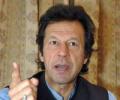
Pakistan's Supreme Court on Wednesday summoned opposition leader Imran Khan and cleric Tahirul Qadri on a petition filed against them over their protests that have called for Prime Minister Nawaz Sharif's ouster.
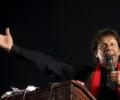
The court also ordered arrest of cleric Tahirul Qadri by November 17 in connection with an attack on the PTV headquarters in 2014.
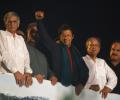
Pakistan opposition leader Imran Khan and cleric Tahirul Qadri tonight marched with thousands of their supporters to enter the heavily fortified 'Red Zone', the capital's diplomatic and political enclave, as minor clashes took place between anti-government protesters and security personnel.

Prime Minister Nawaz Sharif on Thursday ruled out use of force to dislodge the protesters, led by Imran Khan and populist cleric Tahirul Qadri, camping in the heart of the Pakistani capital.
Pakistan's opposition leader Imran Khan on Thursday hardened his stand by withdrawing from dialogue with the government and vowed to continue his fight till the end, apparently buoyed by the Supreme Court's washing off its hands of the protests.
Bracing for two massive anti-government rallies on August 14, Pakistan's Independence Day, Prime Minister Nawaz Sharif on Monday vowed to resist any move to topple his government by a moderate cleric and cricketer-turned-politician Imran Khan who will take out their protest marches on the same day.
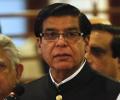
The Supreme Court of Pakistan on Tuesday ordered the arrest of Prime Minister Raja Pervez Ashraf in the Rental Power Plants case.
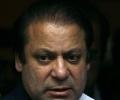
A Pakistani court has ordered the registration of a murder case against Prime Minister Nawaz Sharif, his brother and Punjab Chief Minister Shahbaz Sharif and 19 others for their alleged role in the killing of 14 supporters of fiery anti-government cleric Tahirul Qadri in Lahore.

A tense standoff continued in Pakistan on Saturday as overnight talks between the government and protesters demanding Prime Minister Nawaz Sharif's resignation made little headway in breaking the political logjam.

Extending an olive branch to his opponents, Prime Minister Nawaz Sharif on Tuesday announced to set up a commission of Supreme Court judges to probe the charges of rigging in the last year's elections.

A murder case has been registered against Pakistan Prime Minister Nawaz Sharif, his ministers and other top officials for their alleged involvement in the killing of anti-government protesters here, police said on Wednesday.

Pakistan Supreme Court on Thursday rejected the government's plea to issue an order for the eviction of protesters besieging the Parliament, saying it is an administrative matter and should be dealt with in accordance with the law.
Pakistan Prime Minister Nawaz Sharif on Thursday met President Mamnoon Hussain here and discussed the current political crisis caused due to anti-government protests spearheaded by opposition leader Imran Khan and cleric Tahirul Qadri, demanding the premier's resignation.
A Pakistani court on Saturday ordered framing of murder charges against Prime Minister Nawaz Sharif, his brother and Punjab Chief Minister Shahbaz and 19 others over the June violence near Canada-based cleric Tahirul Qadri's headquarters here that killed 14 of his supporters.

Pakistan's supreme court on Monday ordered the supporters of Imran Khan and cleric Tahirul Qadri to clear the Constitution Avenue within 24 hours so that the movement of judges and officials is not hampered.

Thousands of anti-government protesters led by opposition leader Imran Khan on Saturday reached Islamabad with an aim of ousting Pakistan Prime Minister Nawaz Sharif.

Signs of a possible solution to the political crisis engulfing Pakistan emerged on Tuesday with the embattled government saying it has reached an agreement with Imran Khan's party on most of their demands, except that of Premier Nawaz Sharif's ouster which it said is non-negotiable.

Pakistan Tahreek-i-Insaf chairman Imran Khan on Tuesday demanded formation of a caretaker government after the resignation of Prime Minister Nawaz Sharif which holds fresh elections.

Both Messrs Imran Khan and Tahirul Qadri claim to march independently, but most of Pakistan believes they are marching to the Army's tune

With the political crisis in Pakistan taking a violent turn, the Supreme Court on Monday offered to assist in ending the ongoing impasse between protesters and the Nawaz Sharif government.
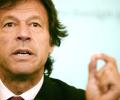
Cricketer-turned-politician Imran Khan has threatened to drag embattled Prime Minister Nawaz Sharif to the Supreme Court to seek his disqualification for allegedly lying about protesters and the army in parliament, as the political logjam showed no sign of easing.

By weakening Sharif, the corps commanders could have a final say in important matters like relations with India, dealing with Taliban militants, interacting with Americans and once again achieving strategic depth in post-NATO Afghanistan. Which is why they may be behind the unrest in Pakistan led by Imran Khan and Dr Tahirul Qadri, says Shahzad Raza.

Determined to oust Pakistan Prime Minister Nawaz Sharif, tens of thousands of protesters on Friday marched towards the capital in two separate convoys as clashes erupted with opposition leader Imran Khan claiming that ruling PML-N activists fired at his vehicle.
Pakistan's powerful army chief has stepped in to mediate between the embattled government and the protesters seeking resignation of Prime Minister Nawaz Sharif, bringing the military back into the centre stage and signaling a possible end to the high-political drama.
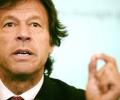
Opposition leader Imran Khan's political party on Monday decided to withdraw its lawmakers from the National Assembly and all provincial assemblies except Khyber Pakhtunkhwa, piling pressure on beleaguered Prime Minister Nawaz Sharif to quit, even as efforts by the ruling PML-N to reach out to anti-government protesters failed.

Amid reports that the Pakistan government was under pressure to allow Pervez Musharraf to leave the country, the former military ruler on Sunday said he will not flee and defend himself in all cases.
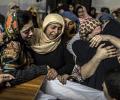
No one should be allowed to use Pakistan's territory to import or export terrorism, says Hamid Mir.

The 'surgical strikes' by India have made the army in Pakistan look unprepared. To prove itself the army will need to hit back: It could be in Kashmir or outside
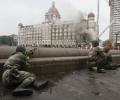
Through its early days to the 1980s, Pakistan sought to expand its sphere of Islamic influence through Afghanistan to Central Asia and got Pakistani citizens recruited in the Afghan government institutions in the 1990s when the Taliban were power. Now, it is looking eastward through India to Bangladesh and Myanmar to establish an imaginary caliphate.

The India card is now almost obsolete. There are more pressing challenges. People of Pakistan are fed up with years of bad governance, corruption and broken promises of successive governments. However, the politicians and former generals are still provoking sentiments on what is happening on the Line of Control for petty political gains, says Shahzad Raza.
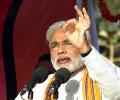
'Both reflect prejudice and short-sightedness peculiar to Mr Modi's way of thinking.'

The developments in Af-Pak region, particularly the fall out of Pak political paralysis, would make President Xi Jinping's task a little more complicated, says Colonel R Hariharan.
